The October 2026 sky
The nights are drawing in fast: on 1 October, true darkness lasts 8 h 45; by the 31st it reaches 10 h 30. And this month the Moon leaves you eleven clear nights in a row. Here is how to make the most of them.
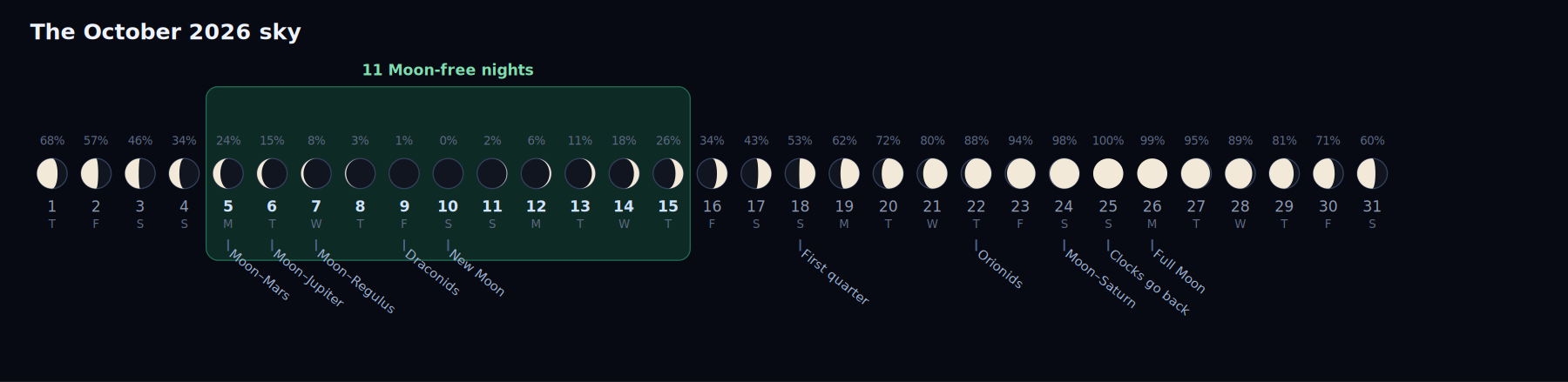
The window of the month: 5 to 15 October
Eleven consecutive nights with the Moon less than 30 % illuminated, five of them below 10 % from the 8th to the 12th. New Moon on 10 October at 17:50.
This is when to point the telescope at the faint stuff — diffuse nebulae, galaxies, anything that needs integration time. After the 18th the Moon takes the sky back: First quarter on the 18th at 18:12, Full Moon on the 26th at 05:11.
The Moon’s appointments
On three consecutive mornings, late in the night, the waning crescent calls on three different objects:
- 5 October — the Moon less than 1° from Mars, both above 40° altitude around 06:00.
- 6 October — the Moon 3° from Jupiter, around 30° altitude.
- 7 October — the Moon 1.6° from Regulus, the leading star of Leo, lower down towards the horizon.
And at the end of the month, on 24 October, the Moon passes within 5° of Saturn — this time in the evening.
The planets
Saturn is the planet of the month. Visible as soon as night falls, it culminates at 41° — at 01:49 early in the month, 22:43 by the end. It is the ideal planetary target for a smart telescope: high, steady, and available at a civilised hour.
Jupiter asks more of you: it rises at 03:10 on 1 October, but already at 00:37 on the 31st. Late night for now, but it is coming back.
Uranus and Neptune are well placed in the evening, at 13° and 31° altitude around 22:00. Little more than coloured dots, but well within reach of a Seestar on short exposures.
Two meteor showers, one good and one spoiled
The Draconids, 8 and 9 October — this is the good news of the month. They fall right on New Moon, with the sky only 1 to 3 % lit. Perfect conditions. A capricious shower, quiet in some years, but when it wakes up it does so properly. And unlike most others, the Draconids are watched early in the evening, not in the small hours.
The Orionids, 21 and 22 October — forget those. The Moon is 80 % lit and does not set until 03:36. It will swallow everything. If you insist on trying, aim for the last hour before dawn.
The best targets of the month
Altitudes calculated at 23:00, mid-October, for latitude 50° N:
| Target | Altitude |
|---|---|
| NGC 7635 — Bubble | 78° |
| Sh2-155 — Cave | 78° |
| IC 1396 — Elephant’s Trunk | 77° |
| NGC 281 — Pacman | 71° |
| NGC 7000 — North America | 70° |
| M31 — Andromeda | 69° |
| M33 — Triangulum | 54° |
| M27 — Dumbbell | 47° |
| NGC 1499 — California | 34° |
| M45 — Pleiades | 28° |
The first four pass almost overhead: this is the time of year when they are at their easiest, with the least atmosphere to shoot through. The Helix (NGC 7293) only climbs to 19° from this latitude — doable, but save it for a perfectly transparent night.
Don’t forget
European clocks go back on the night of 24–25 October. You gain an hour of darkness in civil time: on 31 October, true darkness begins as early as 19:14. Observing evenings become compatible with a normal life again.
These figures are for latitude 50° N in northern France, and all times are local — CEST until 25 October, CET afterwards. Further south everything climbs a few degrees, and the Helix becomes distinctly more comfortable. NightAstro recalculates all of it for your own position, your real horizon and your instrument: open the planner and see what is observable from where you are tonight.