Which smart telescope should you buy for the 2026 holidays?
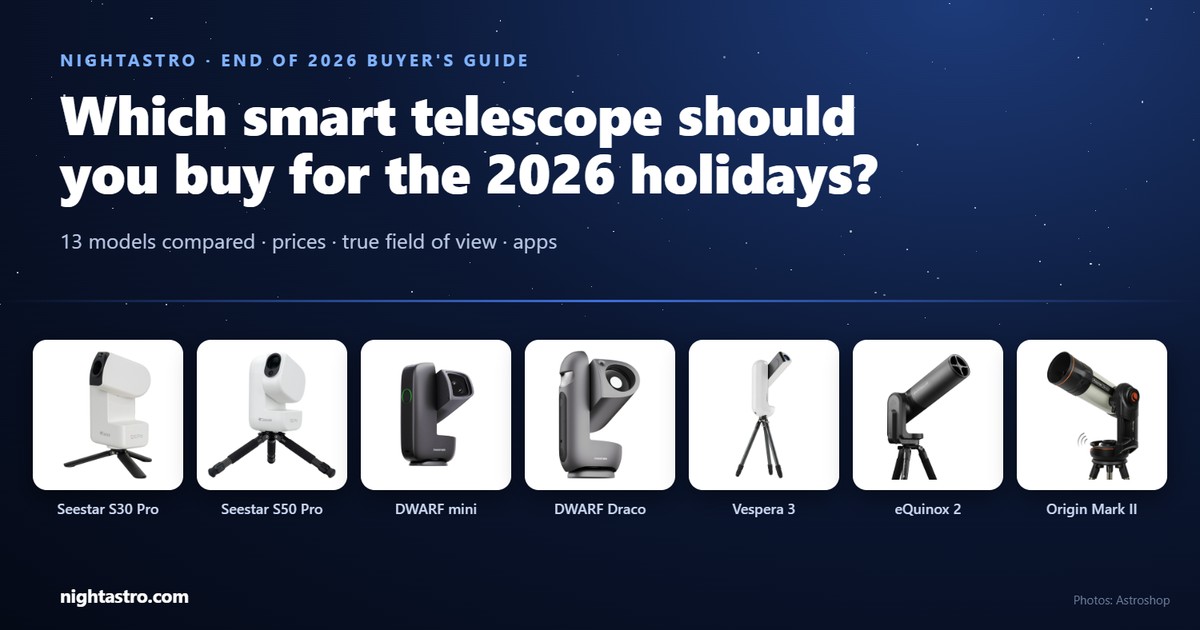
There is no single best smart telescope: there is the right model for your sky, your targets and your budget, from €429 to over €5,000.
This guide reviews the 12 models on sale at the end of October 2026 from ZWO (Seestar), DwarfLab, Vaonis, Unistellar and Celestron. Fields of view are recalculated from each sensor and focal length, because manufacturers often quote the diagonal, which makes comparisons misleading.
It is also the list of instruments NightAstro supports: once you have chosen your telescope, the tool tells you every evening which targets fit in its field.
The criteria that really matter
Field of view decides what you can photograph; everything else refines the choice.
- Field of view: a wide field (2.5° to 4°) frames large nebulae in full (Rosette, Horsehead with Alnitak, Andromeda). A narrow field (under 1°) suits distant galaxies and planetary nebulae. Beware: « 4.6° » on a product page is often the diagonal, meaning 4° × 2.2° in reality.
- Aperture: the larger it is, the more light the telescope gathers and the faster the signal builds. It ranges from 30 mm (Seestar S30, DWARF mini) to 152 mm (Celestron Origin).
- Image scale: the patch of sky covered by one pixel, in arcseconds. Around 1.5″/px, details are fine; around 4″/px, the image is softer but the field wider.
- Weight: from 840 g (DWARF mini) to 19 kg (Origin, tripod included). A light model gets used more often.
- Battery life: from 4 h to 11 h. Beyond 6 h, a full night runs without an external battery.
- Equatorial (EQ) mode: mounted on a wedge tilted toward the celestial pole, the telescope removes field rotation and allows longer exposures (60 to 90 s). Useful for long sessions on a single target.
- Built-in filters: a dual-band filter (Hα + OIII) lets you photograph nebulae from the city. It is built in at ZWO and DwarfLab, optional at Vaonis and Celestron.
Comparison table
The 12 models on sale, from cheapest to most expensive. Field = true width × height of the image.
| Model | Price | Aperture | True field | Weight | Battery | EQ mode |
|---|---|---|---|---|---|---|
 DWARF mini |
€429 | 30 mm | 2.13° × 1.20° | 0.84 kg | ≈ 4 h | Yes (90 s) |
 Seestar S30 |
€479 | 30 mm | 2.13° × 1.20° | 1.65 kg | ≈ 6 h | To be confirmed |
| DWARF 3 | €529 | 35 mm | 2.93° × 1.65° | 1.35 kg | ≈ 5.5 h | Yes (60 s) |
 Seestar S30 Pro |
€699 | 30 mm | 3.99° × 2.24° | 1.65 kg | 5–6 h | Yes, with TH10 head (60 s) |
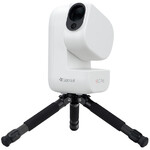 Seestar S50 Pro |
€999 | 50 mm | 2.45° × 1.38° | 2.8 kg | ≈ 9 h | Yes, with TH10 head |
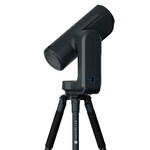 Unistellar Odyssey |
€2,399 | 85 mm | 0.75° × 0.56° | 4 kg | 5 h | No |
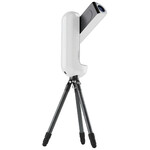 Vaonis Vespera 3 |
€2,490 | 50 mm | 2.60° × 1.46° | 5 kg | 11 h | No |
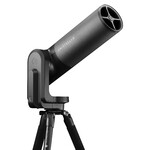 Unistellar eQuinox 2 |
€2,577 | 114 mm | 0.76° × 0.57° | 9 kg | 11 h | No |
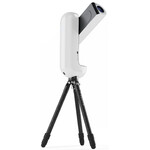 Vaonis Vespera Pro II |
€2,990 | 50 mm | 1.65° × 1.65° | 5 kg | 11 h | No |
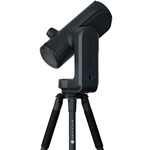 Unistellar Odyssey Pro |
€4,199 | 85 mm | 0.75° × 0.56° | 4 kg | 5 h | No |
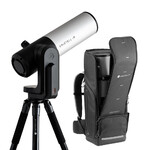 Unistellar eVscope 2 |
€4,858 with backpack | 114 mm | 0.76° × 0.57° | 9 kg | 9 h | No |
 Celestron Origin Mark II |
€5,499 | 152 mm | 1.32° × 0.75° | 18.9 kg (with tripod) | 6 h or more | Yes, with equatorial wedge |
Retail prices checked on 24 October 2026 at Astroshop. Photos: Astroshop.
Prices vary with promotions. The original Seestar S50 is hard to find now, and the end of sales of the DWARF 3 has been reported by a price comparison site and it is no longer sold at Astroshop, but DwarfLab has not confirmed it.
Our picks by profile
To get started without breaking the bank, the Seestar S30 Pro offers the best balance of price, field of view and image quality.
- Tight budget, under €500: DWARF mini (€429) if weight matters most, Seestar S30 (€479) for the Seestar ecosystem and app. Both have a 2 MP sensor: fine to start with, limited for enlarging images.
- Best value, €700: Seestar S30 Pro. 4K sensor, the widest field on the market (4° × 2.2°) for large nebulae, 1.65 kg, and a second wide-angle camera for the Milky Way.
- More detail without blowing the budget, €1,000: Seestar S50 Pro. 50 mm aperture, the same as Vespera models costing 2.5 times more, and up to 9 h of battery life.
- Premium build and long nights, €2,500 to €3,000: Vaonis Vespera 3 for a wide field, Vespera Pro II for resolution (12.5 MP, square field). 11 h of battery life, designed in Montpellier, France, 5-year warranty.
- Small galaxies and eyepiece viewing, €2,400 to €4,700: Unistellar. The 85 to 114 mm aperture and narrow field (0.75°) favour compact objects; the Pro and eVscope 2 versions add a Nikon electronic eyepiece.
- Backyard observatory, €5,500: Celestron Origin Mark II. The largest aperture (152 mm at f/2.2), so the fastest signal, but 19 kg to set up.
One to watch: the DWARF Draco (90 mm, €1,499 on pre-order, deliveries announced for November 2026) could shake up the €1,000 to €2,500 range.
The brands at a glance
ZWO Seestar
The best-selling range, with four models from €479 to €999. The Pro versions move to a 4K sensor (8.3 MP) and add a 63° wide-angle camera for the Milky Way and star trails. Dual-band and solar filters included. EQ mode requires the TH10 tripod head, sold separately.
DwarfLab
The most compact: 840 g for the DWARF mini, 1.35 kg for the DWARF 3. Three built-in filters, including a dual-band one on the DWARF 3, and an EQ mode with exposures up to 90 s on the mini. The DWARF 3 offers a 2.9° × 1.65° field for €529, and the Draco arrives in November 2026 (details below).
New: DWARF Draco. DwarfLab’s first large-aperture model, a 90/340 mm catadioptric at f/3.8, shipping from 5 November 2026 according to Astroshop.
| Specification | DWARF Draco |
|---|---|
| Optics | Catadioptric, 90 mm, 340 mm focal length, f/3.8 |
| Main sensor | OmniVision OV50Q40, 1/1.3″, 50 MP (1.2 µm pixels), about 12 MP for deep sky (2×2 binning) |
| True field of view | ≈ 1.66° × 1.24° (calculated, to be confirmed by DwarfLab) |
| Image scale | ≈ 1.46″/px with 2×2 binning |
| Wide-angle camera | 1/1.8″, 73° × 58° field |
| Built-in filters | Astro, dark, ND solar, dual-band Hα + OIII; the SHO edition adds a dual-band SII + OIII |
| Max exposure | 300 s, alt-azimuth and equatorial modes |
| Other | Field derotation via rotating sensor, cooled sensor, dew prevention, built-in guide scope |
| Weight | 5.5 kg |
| Battery life | ≈ 5 h (77 Wh) |
| Price | €1,499 (Standard), €1,669 (SHO), on pre-order |
With a field close to the Vespera Pro II’s, more aperture and 5-minute exposures for €1,499, it takes direct aim at the high end. No independent review has been published yet: to be confirmed on release.
Vaonis
French brand, high end. The Vespera 3 and Vespera Pro II share the same 50/245 mm optics and 11 h of battery life; the first focuses on field (2.6° × 1.46°), the second on resolution (12.5 MP, 1.65° × 1.65°). Mosaic mode widens the field up to 4.3° × 2.4°. Filters optional.
Unistellar
Reflector telescopes from 85 to 114 mm, with a narrow field of about 0.75° × 0.56°: ideal for galaxies and planetary nebulae, too tight for large nebulae. The only models on the market with an eyepiece (Odyssey Pro, eVscope 2). Built-in citizen science programme. No EQ mode.
Celestron
The Origin Mark II (2025) is the only 152 mm model: RASA optics at f/2.2 and an 8.3 MP IMX678 sensor. Filter drawer for 1.25″ and 2″ filters, no filters supplied. EQ mode available since June 2025 with an equatorial wedge. At 18.9 kg, it is a backyard instrument rather than a travel companion.
The apps
All the apps are free and handle the essentials (GoTo, tracking, live stacking); they differ in planning, mosaics and access to raw files.
- Platforms
- iOS, iPadOS, Android, Apple silicon Mac
- Plan a night
- Yes, Plan mode with auto-generation and plan sharing
- Several nights on one target
- Not announced in the app
- Mosaic
- Yes, including in Plan mode
- Raw files
- FITS, exportable from the app
- Highlights
- AI processing (denoise, curves), comet nucleus stacking, photometry
- Platforms
- iOS, iPadOS, Android
- Plan a night
- Yes, with target sequences and mosaics
- Several nights on one target
- Yes, Mega Stack merges several sessions
- Mosaic
- Yes, Astro Mosaic
- Raw files
- FITS and TIFF
- Highlights
- Built-in Stellar Studio editing (denoise, star removal), cloud panorama stitching
- Platforms
- iOS, Android
- Plan a night
- Yes, Plan My Night
- Several nights on one target
- Yes, PerseverENS resumes the target and stacks automatically
- Mosaic
- Yes, CovalENS, over several nights
- Raw files
- FITS and 16-bit TIFF in Expert mode
- Highlights
- Very polished design, mosaics without field rotation
- Platforms
- iOS, Android
- Plan a night
- No, but predictions for science missions
- Several nights on one target
- Not announced
- Mosaic
- No
- Raw files
- RAW images downloadable, accessible from a computer
- Highlights
- Citizen science with the SETI Institute (asteroids, exoplanets, satellites), several observers connected
- Platforms
- iOS 16+, Android 12+
- Plan a night
- Yes, scheduled overnight observations
- Several nights on one target
- Not announced
- Mosaic
- Not announced
- Raw files
- Raw images kept, retrievable via USB
- Highlights
- Several devices connected at once, casting to a TV
For post-processing, Seestar, DWARFLAB and Vaonis give easy access to FITS files: that is what you need to go further, for example with AutoStack for Seestar and DWARF users.
In short
For most beginners, a Seestar S30 Pro or S50 Pro covers the essentials for under €1,000; beyond that, you pay for build quality, battery life or a large aperture.
Whatever you choose, two free tools are there to help:
- NightAstro tells you every evening what to point at, taking into account your telescope, the weather, the Moon and your real horizon.
- AutoStack stacks the raw images (FITS) from your Seestar or DWARF in one click, ready for post-processing in the software of your choice.
Already equipped?
See what your telescope can capture tonight
NightAstro picks the best targets of the night for you, based on your location, the weather, the Moon and your instrument. Free, nothing to install.
See tonight’s targets →And to stack your photos in one click: AutoStack, free
Sources
- ZWO – Seestar S30 FAQ, Seestar S30 Pro FAQ, Seestar S50 Pro (EU store)
- Unistellar – European store
- Sterngucker – smart telescope comparison, Celestron Origin Mark II
- Skies & Scopes – Best Smart Telescopes 2026, Dwarflab Draco
- Apps: Seestar, DWARFLAB, Vaonis Singularity, Unistellar
- Clifton Cameras – Vespera Pro II, Skypoint – DWARF 3
Affiliate links: this article contains links to Astroshop. If you buy through them, NightAstro earns a small commission at no extra cost to you. It helps pay for web hosting and the development of new features, and keeps NightAstro free. It does not influence our recommendations. You can also support the project directly at ko-fi.com/nightastro.