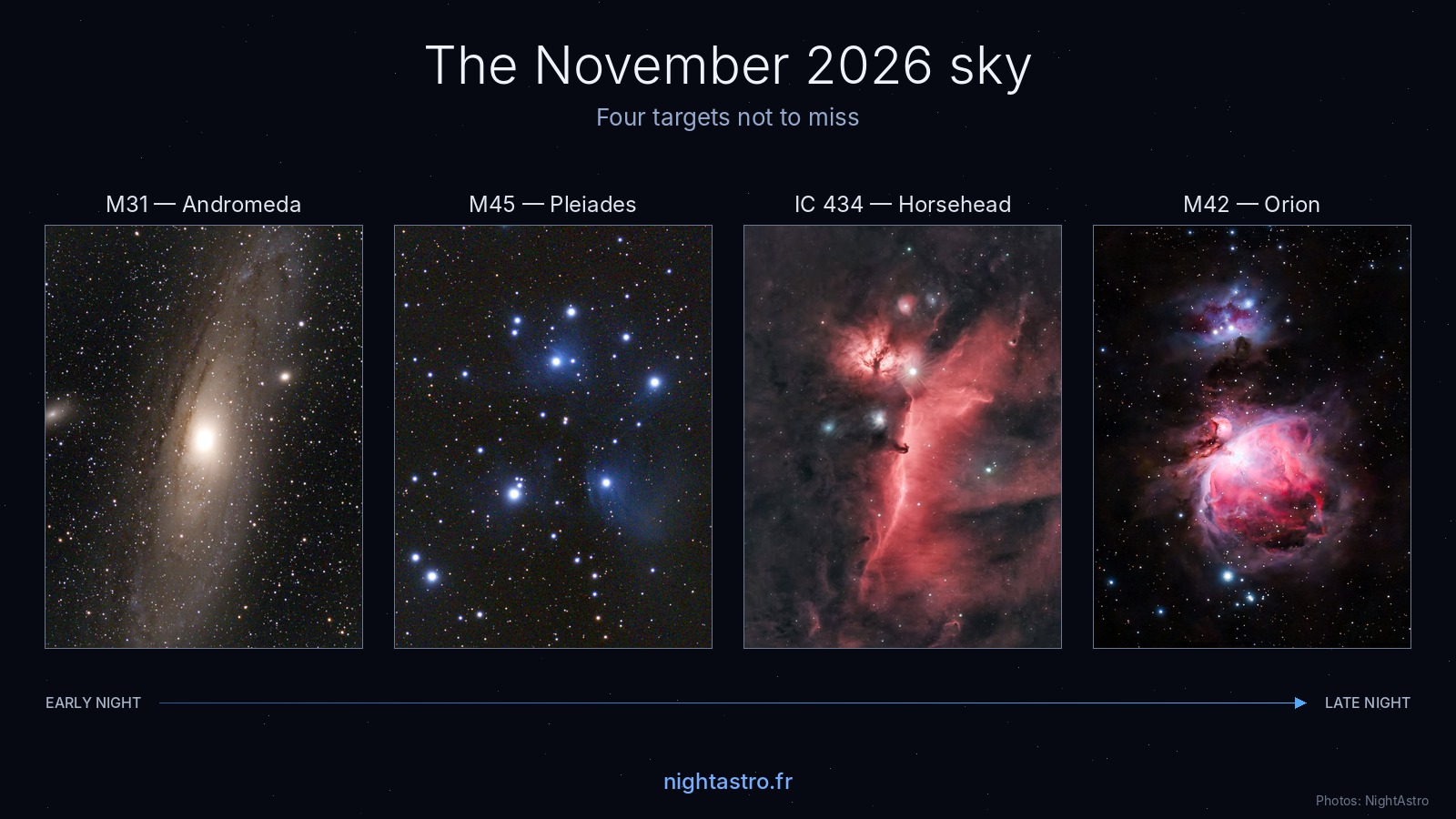
The November 2026 sky
The nights are close to their longest: on 1 November, full darkness lasts 10 h 35 min; by the 30th, 11 h 40 min, starting as early as 6:50 pm. This month brings a fine moonless window early on, and a lovely pairing of Mars and Jupiter to admire before dawn.
The window of the month: 3 to 14 November
Twelve nights in a row with the Moon less than 30% lit, including six below 10% from the 6th to the 11th. New Moon on 9 November at 8:02 am.
This is the time to point your telescope at faint targets: diffuse nebulae, galaxies, anything that needs long integration. After the 17th, the Moon takes over the sky again: First Quarter on the 17th at 12:47 pm, Full Moon on the 24th at 3:53 pm.
The best targets of the month
Altitudes calculated at 11 pm, mid-November, for northern France:
| Target | Altitude |
|---|---|
| NGC 869/884 — Double Cluster | 82° |
| NGC 891 | 81° |
| NGC 281 — Pacman | 79° |
| IC 1805 — Heart | 77° |
| IC 1848 — Soul | 76° |
| M31 — Andromeda | 75° |
| M33 — Triangulum | 71° |
| NGC 7635 — Bubble | 66° |
| NGC 1499 — California | 63° |
| M45 — Pleiades | 56° |
The Heart and Soul pass overhead: the ideal pair for a dual-band (LP) filter. And Orion is on its way: M42 and the Horsehead (IC 434) rise late in the night, with M42 already reaching 35° around 2:50 am. Be patient: they will be the pair of the winter.
Moon encounters
- 20 November, evening: the Moon 5° from Saturn, 42° high around 7:45 pm.
- 24 November: the Full Moon 4° from the Pleiades early in the evening. A lost night for deep sky.
- Night of 28–29 November: the Moon crosses the Beehive Cluster (M44), 0.3° away around midnight.
- 30 November, early morning: the Moon 2° from Jupiter, 52° high around 6:30 am.
A naked-eye sight: Mars and Jupiter together
On 16 November, Mars passes 1.2° from Jupiter, in Leo: two bright points close together, one white, one orange. Enjoy it with the naked eye or binoculars around 6 am, before dawn, more than 50° high. From the 14th to the 18th, the gap stays below 1.6°. On the 26th, Mars then passes 1.7° from Regulus.
The planets in the sky
- Saturn is visible from nightfall and peaks at 41°, around 10:40 pm early in the month and 8:45 pm at the end.
- Uranus reaches opposition on 25 November: visible all night, in Taurus, not far from the Pleiades.
- Neptune is visible in the early evening.
- Mars and Jupiter rise around midnight.
- Venus shines in the east before dawn.
- Mercury makes a brief, very low appearance at dawn from the 17th to the 25th.
Meteor showers
The Taurids, on the 5th (Southern) and the 12th (Northern): few in number (about 5 per hour), but slow and sometimes spectacular, with fine fireballs. The Moon stays discreet on both dates.
The Leonids, night of 17–18 November: about 15 per hour. The Moon sets around 12:15 am; the best window runs from 1 am to 5:30 am, as the radiant climbs in Leo.
Don’t forget
November is the month of humidity: under clear skies, dew and frost come quickly. Bring a dew heater and a fully charged battery, as the cold drains it faster. To know whether the night is worth it, see our guide to reading an astronomy forecast.
These altitudes apply to a latitude of 50° N. Further south, everything climbs a few degrees higher. NightAstro recalculates everything for your location, your real horizon and your instrument: open the planner and see what you can observe from home tonight.