Reading the astronomy forecast: meteoblue’s “Astronomy Seeing” table explained
Before taking out your smart telescope, one question matters more than any other: will tonight really be good? meteoblue’s “Astronomy Seeing” table is one of the most complete tools to answer it… provided you know how to read it. Here is how to understand it, column by column.
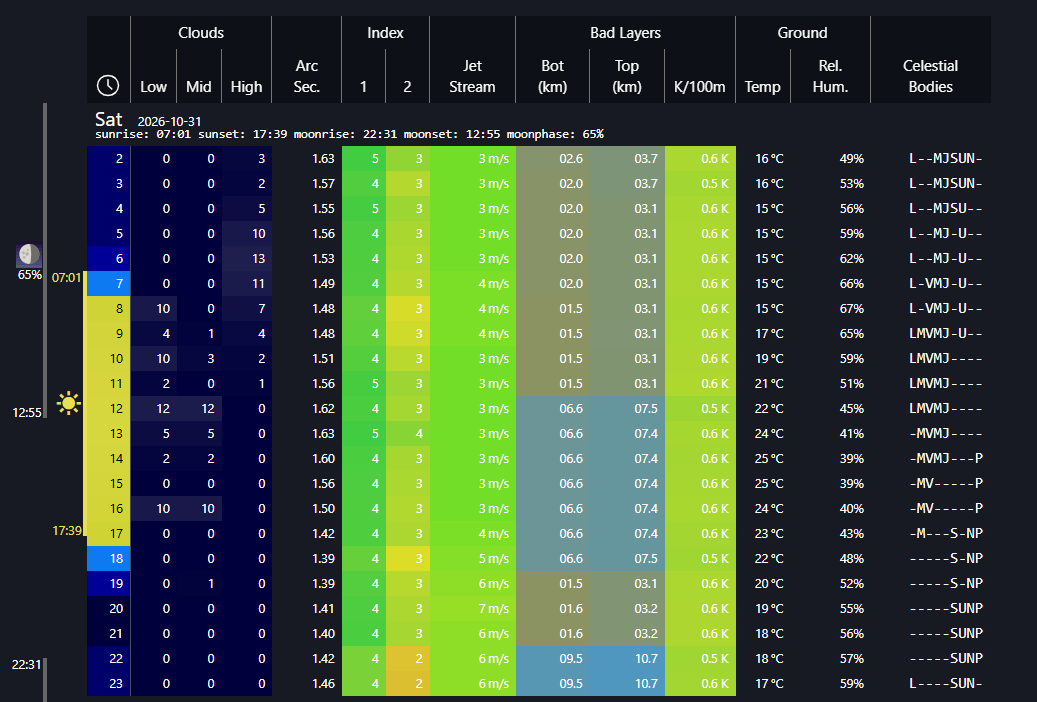
meteoblue’s “Astronomy Seeing” table: one row per hour, one column per criterion.
Where to find it
On meteoblue.com, Astronomy Seeing section, search for your town. The table gives one row per hour (local time) over several days. At the top of each day: sunrise and sunset, moonrise and moonset, and the illuminated fraction of the Moon (moonphase).
On the left of the table, a timeline sums up the day at a glance: the yellow bar covers daylight hours, between sunrise and sunset; the Moon icon shows how much of it is lit, and the grey bar next to it marks when it is up, with its rise and set times. An hour on a dark blue background in the first column means full darkness.
1. Clouds: the number one criterion
The three Clouds columns give cloud cover in percent, by layer:
- Low: low clouds, from 0 to 4 km. They block everything.
- Mid: mid-level clouds, from 4 to 8 km.
- High: high clouds, from 8 to 15 km. Thin and often transparent, they let bright stars through but veil deep-sky objects.
Dark blue means a clear sky; the lighter the cell, the more clouds. Note: fog does not show in these columns. If the clouds are bad, there is no need to look any further.
2. Seeing: air turbulence
Even under a perfectly clear sky, the air can be unsteady: stars “dance” and fine details blur. This is seeing.
- Arc Sec.: the size of the smallest visible detail, in arcseconds. The smaller the better: under 1″ is exceptional, between 1″ and 2″ is good, above 2.5″ is average.
- Index 1 and Index 2: two estimates of air stability, from 1 (bad) to 5 (excellent). Index 2 is more sensitive to “flickering”. Green = good, red = bad.
Good to know: for deep-sky imaging (nebulae, galaxies) with a Seestar or a DWARF, seeing matters fairly little, as each pixel already covers 2 to 3 arcseconds. It becomes essential for the Moon and planets, where you are after the finest details.
3. Jet stream and turbulent layers
- Jet Stream: wind speed at high altitude. Above 35 m/s, seeing is usually poor (and, oddly, also below 5 m/s). Green = good.
- Bad Layers: turbulent air layers, with their base (Bot) and top (Top) altitude in kilometres, and the temperature gradient that makes them turbulent (K/100m). The more there are, the more the image shimmers.
4. Ground: temperature and humidity
Temp and Rel. Hum. give the ground temperature and humidity. Above 85-90% humidity, dew threatens your optics: think of the dew heater, and protect your gear at the end of the session.
5. Visible bodies
The last column, Celestial Bodies, shows at a glance what is above the horizon. Each position stands for one body, in this order: L (Moon), Mercury, Venus, Mars, Jupiter, Saturn, Uranus, Neptune, Pluto. A letter means the body is up; a dash means it has set. So “—–S-NP” means Saturn, Neptune and Pluto are up, but not the Moon.
For deep-sky imaging, the Moon is the other big criterion after clouds: a bright Moon high in the sky washes out nebulae and galaxies.
Example: three nights compared
Nothing beats a comparison to learn how to read this table. Here are three very different evenings.
1. The ideal night
This is the table shown at the top of this article.
- The cloud columns stay at 0% all evening: dark blue from top to bottom.
- Seeing is good: about 1.4″, index 1 at 4 and index 2 at 3, in green.
- The jet stream is weak (5 to 7 m/s) and humidity moderate (48 to 59%): no dew to worry about.
- Saturn is up from nightfall, followed by Uranus and Neptune (“—–SUNP”).
- The Moon, 65% lit, only rises at 22:31.
Verdict: an excellent night. Deep-sky targets are best between the end of twilight and moonrise; with 1.4″ seeing, it is also a very good evening for Saturn.
2. The mixed night
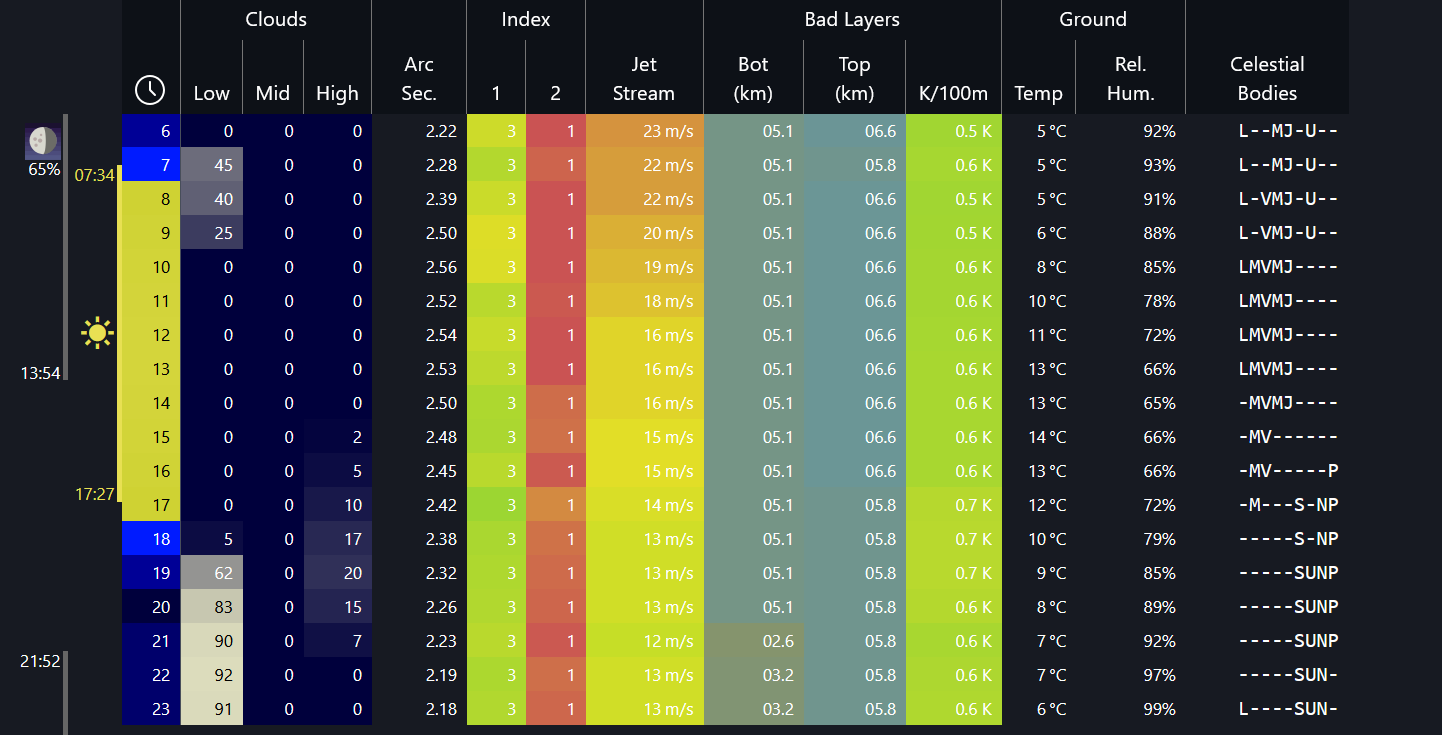
- Just after sunset, the sky is almost clear: only a few high clouds.
- An hour later, low clouds rise to 62%, then 83-92%: the night clouds over.
- Humidity climbs from 79% to 99%: dew guaranteed.
- Seeing is average: 2.2 to 2.4″, index 2 at 1 (red).
Verdict: a short window at the very start of the evening, just enough for Saturn. For deep-sky, better wait for another night.
3. The night to forget
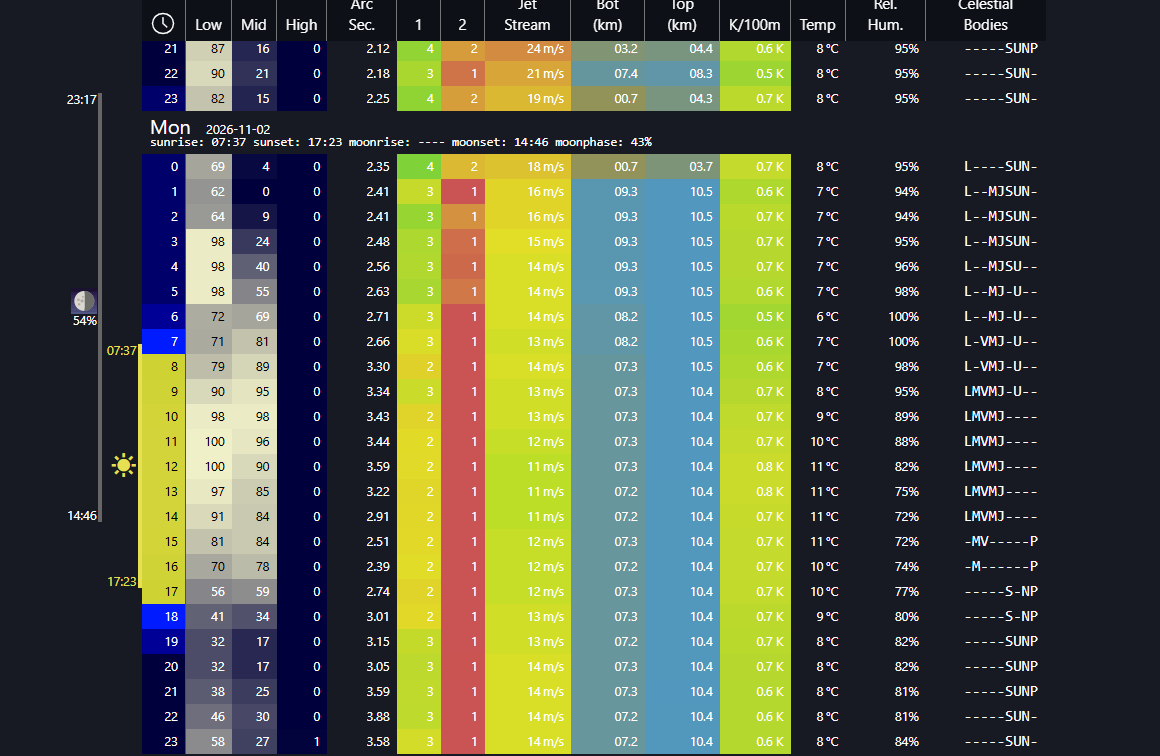
- Low and mid-level clouds are there all evening (30 to 60% each): light cells dominate.
- Seeing is poor: 2.7 to 3.9″, index 2 at 1 (red from start to finish).
- The jet stream blows at 12-14 m/s and humidity never drops below 77% (up to 100% during the night).
Verdict: nothing to hope for, neither deep-sky nor planets. The telescope stays indoors.
What the comparison shows: everything comes down first to clouds and humidity. Seeing comes next, and makes the difference between a blurry Saturn and a detailed one.
The method in a nutshell
- 1. Clouds: dark blue columns over your time slot.
- 2. The Moon: set or barely lit for deep-sky.
- 3. Humidity: plan for dew control above 85%.
- 4. Seeing: mostly for the Moon and planets.
Once you have found a good night, you still need to choose what to photograph: that is what NightAstro is for, suggesting targets suited to your smart telescope, your location and your evening.
Clear skies!